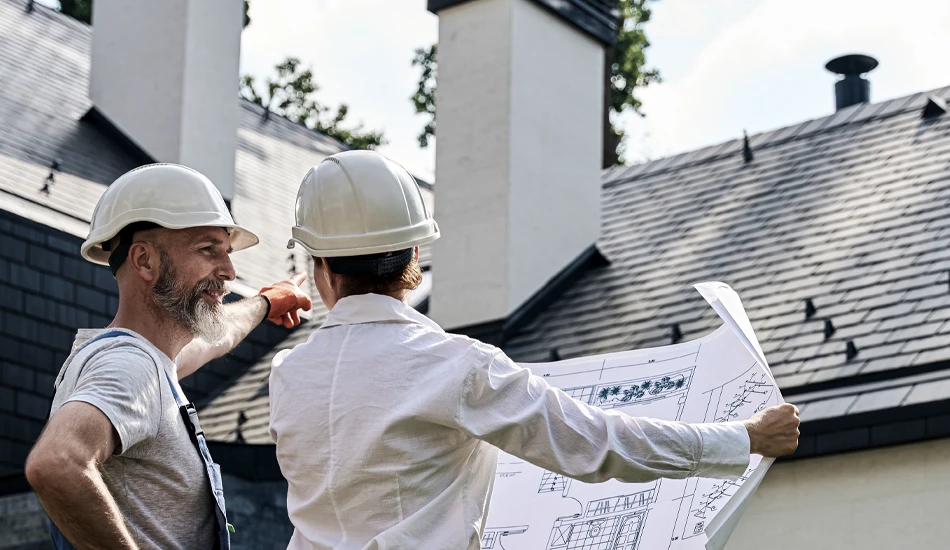
Safety discussions in roofing tend to center on installation — fall protection gear, harness requirements and steep-slope protocols — and rightfully so; that’s where workers spend the most time on a roof.
In fact, according to the Bureau of Labor Statistics, roofing is the third deadliest occupation in the country — and in 2023, 82% of roofing fatalities came from falls.
But the estimating phase puts people on roofs too, often without the same level of preparation or protection.
Every roof visit — for any reason — carries real exposure. And while some roof visits during the bidding process are unavoidable, reducing how often you or your team climbs a roof to gather measurements is a straightforward way to reduce that exposure.
The fewer trips your team makes onto a roof, the lower your exposure — and roofing estimating software with aerial measurement tools makes that tradeoff effortless, giving commercial roofers accurate measurements without ever leaving the ground.
Key Takeaways
- Roofing is the third deadliest occupation in the U.S., with falls accounting for 82% of fatalities in 2023
- Every roof visit during the estimating phase carries the same fall risk as a visit during installation
- OSHA compliance applies to estimating visits, too — adding another reason to reduce unnecessary roof access
- Aerial measurement tools let estimating teams build accurate bids without unnecessary site visits
- The EDGE® integrates with EagleView to bring remote roof data directly into the estimating workflow
The Risk Doesn’t Start at Installation
Every pre-bid roof visit carries the same fall exposure as an active installation. But your estimating team visits roofs throughout the bidding process — sometimes multiple times per job, across dozens of jobs a year.
Each of those visits is an exposure event.
Roof conditions vary. Weather changes. Surfaces that look walkable aren’t always. And pre-bid visits typically don’t come with the same safety setup as active jobsites.

What OSHA Actually Requires
OSHA’s fall protection standard doesn’t make an exception for estimating visits.
OSHA’s fall protection standard under 29 CFR 1926.501 requires fall protection for any worker on a surface with an unprotected edge six feet or more above a lower level.
For an estimating team running multiple site visits per week, this means every pre-bid roof access requires the same fall protection planning as active installation work.
Harnesses, anchor points and proper equipment are required for a measurement visit. Reducing how often those visits happen isn’t just an efficiency play. It’s also a way to reduce regulatory exposure.
How Aerial Measurement Changes the Equation
Aerial measurement tools give estimating teams a direct way to cut roof access — and the fall exposure that comes with it. The most direct way to reduce fall risk during estimating is to reduce how often your team needs to physically access a roof.
Aerial measurement technology makes that a realistic option for most jobs.
Instead of visiting a site to manually measure each plane, your team enters an address and pulls detailed roof data — pitch, surface area, dimensions — from high-resolution aerial imagery.
That data flows directly into the estimating software, and the bid-building process starts without anyone leaving the office.
The EDGE and EagleView Integration
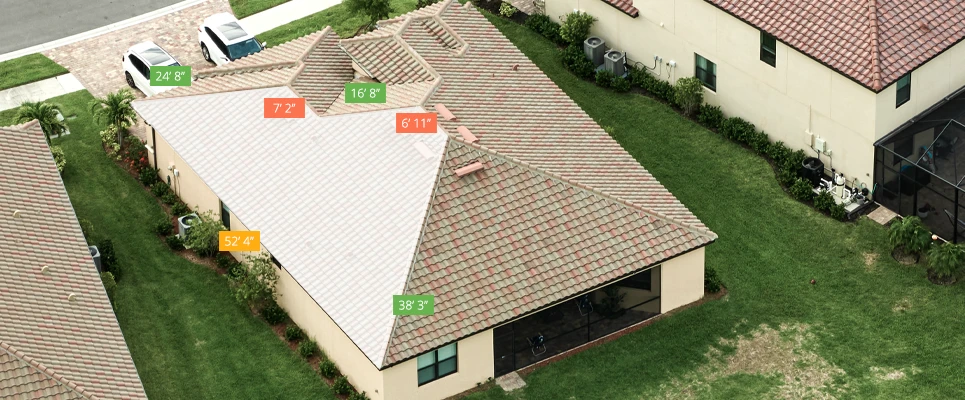
The EDGE is all-in-one takeoff and estimating software built specifically for roofing. It’s designed to handle trade-specific pricing, material calculations and bid assembly in a single workflow.
EagleView is an aerial imaging platform that collects high-resolution roof data from aircraft and satellite imagery. It delivers precise measurements — pitch, dimensions, surface area — without requiring anyone to physically access the property.
The EDGE and EagleView work together so that when a report is ordered, that data flows directly into the estimating workflow — no manual re-entry, no switching between platforms.
From there, your estimators can build a full, trade-specific bid without setting foot on a roof.
EagleView reports deliver the key data points your estimators need:
- Pitch measurements to determine material waste and labor difficulty
- Detailed roof dimensions for precise perimeter and ridge lengths
- Total surface area calculations to automate material ordering and cost estimates
For government and commercial jobs, those data points are often enough to build an accurate estimate without a site visit.
And if a visit is necessary, your team knows exactly what they’re walking onto.
Accuracy You Can Bid With Confidence
A common question is whether remote measurements hold up against manual ones.
EagleView, for example, reports accuracy levels above 95% for most residential roofs. That’s well within the margin needed to submit a competitive, profitable bid.
When a job does require a site visit — unusual roof conditions, complex commercial work, storm damage assessment — your team makes one targeted trip with full context, instead of multiple exploratory climbs.
Making Safer Estimating a Standard Practice
Companies that treat remote measurement as the default — not the fallback — see fewer site visits, faster turnarounds and lower risk across the board.
Fewer trips per job means roofing estimators spend less time in transit and more time building bids.
Order the aerial report first. Build the estimate. Only put someone on the roof when there’s a specific reason that remote data can’t answer.
That shift in process is how safety actually improves over time — not as a standalone initiative, but as part of how the work gets done every day.

Put Better Tools to Work for Your Team
Roofing remains one of the most hazardous trades in construction. Protecting your estimating team starts with giving them tools that reduce unnecessary exposure.
By centralizing your takeoff, pricing, and aerial data in one platform, you create a more efficient office and a safer environment for your field team.
Through its integration with EagleView, your team can pull accurate aerial roof measurements straight into a trade-specific estimate — fewer site visits, faster bids and a safer process from the start.
To see how it fits your operation, connect with an expert and book a demo.